




Efficient Algorithm Slashes Pulsar Discovery Time
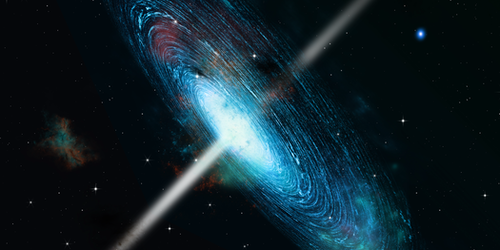

In its 18 years of operation, the Fermi Large Area Telescope (Fermi-LAT) has detected gamma-ray photons from more than 300 pulsars, rapidly spinning neutron stars with powerful magnetic fields. Yet hundreds of gamma-ray signals that are suggestive of pulsars remain unattributed. Daniel Pook-Kolb of the Max Planck Institute for Gravitational Physics in Germany and his colleagues have now used a new, more efficient algorithm to scratch one signal off the “unknown” list [1]. Their identification of a previously unknown gamma-ray pulsar could herald the discovery of many more that have previously been undetectable.
Fermi-LAT records the arrival times, directions, and energies of gamma-ray photons with many different origins. Sifting this catalog for pulsars is computationally challenging because the data are scarce. A given pulsar might spin hundreds of millions of times for each individual photon detected from it. Identifying a pulsar from such a sparse signal means filtering out a vast number of possible pulsar rotation models to find one that matches the data.
To efficiently identify the right rotation model, Pook-Kolb’s team improved on a recently developed method that uses tools from cryptography. This technique transforms the pulsar search problem into a classical puzzle in geometry. Possible numbers of pulsar rotations are represented by points on a discrete, high-dimensional lattice. A rotation model that fits the photon detections appears closest to the origin of the lattice, allowing geometrical algorithms to rule out huge numbers of improbable matches. Using this improved technique, the researchers discovered PSR J1622-7204, a neutron star spinning at 261 Hz, which had been missed by supercomputer-based searches. The new method used about one millionth of that computational power—an hour on a normal laptop.
–Rachel Berkowitz
Rachel Berkowitz is a Corresponding Editor for Physics Magazine based in Vancouver, Canada.
References
- D. Pook-Kolb et al., “Gamma-ray pulsar discovery using a lattice-based method,” Phys. Rev. Lett. 137, 211201 (2026).