




Dark-Matter Sensitivity Improved with a Xenon Still
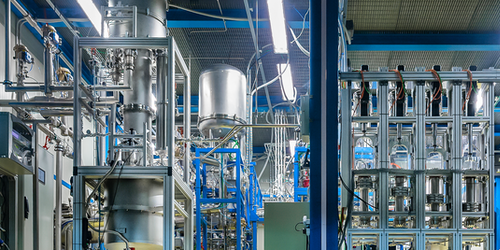

Researchers are using whiskey-still technology to significantly improve their search for dark matter. The XENONnT Collaboration has been looking for signs of dark matter in a tank containing 6 metric tons of liquid xenon. The most significant dark-matter-impostor (background) events come from decays of tiny amounts of radioactive radon. Using a whiskey-still-like system, the team has now reduced the amount of radon so much that its effect is comparable to that of solar neutrinos—the next most significant source of background events and one that is impossible to avoid [1]. The researchers expect this purification technique to be essential for the next generation of dark-matter searches. Such low radon backgrounds may also signal the end of the era of rapid sensitivity improvements.
Most impurities only need to be removed once, but radon, which is found in nearly every material, is a gas whose atoms are born in energetic radioactive decays. So radon emanates from every surface of the XENONnT experiment and constantly streams into the liquid xenon. The collaboration has now developed a system that continually circulates the xenon through several stages of cryogenic distillation. The more volatile xenon is removed from the top of the structure, while the less volatile radon collects at the bottom. The concept is similar to that of a whiskey still, which separates alcohol from water.
XENONnT will be followed by a next-generation xenon observatory called XLZD, which will also implement the distillation technique. The researchers expect XLZD’s radon background to be one-tenth that of solar neutrinos, which can’t be reduced by shielding. “After that, further radon reduction will not actually help, and improvements in dark-matter searches will be more difficult,” says XENONnT team member Christian Weinheimer of the University of Münster in Germany.
–David Ehrenstein
David Ehrenstein is a Senior Editor for Physics Magazine.
References
- E. Aprile et al. (XENON Collaboration), “Radon removal in XENONnT down to the solar neutrino level,” Phys. Rev. X 15, 031079 (2025).