




Thought Experiment: Bright Visions of Future Energy

“Modern civilization is the daughter of coal, for this offers to mankind the solar energy in its most concentrated form.” With those words, chemist Giacomo Ciamician opened an address to the International Congress of Applied Chemistry, held in New York City in September 1912. Coal was king then. Petroleum would not supplant it as the world’s principal source of energy until the 1950s. Even so, as Ciamician noted in his lecture, the accumulated supplies of both fuels would eventually run out. To avert an energy famine, he proposed that humans make chemical fuels as plants do, by harnessing light.
Leap forward to an imagined future: Paul McAuley’s novel The Quiet War (2008) opens in 2144. Human colonists known as Outers live on Callisto, Ganymede, and other moons of Jupiter and Saturn. Originally settlers on Mars, the Outers fled to these moons in the wake of a war they provoked with Earth—and lost. They sustain themselves in their distant refuge through advanced technologies, including genetically engineered photosynthetic organisms.
McAuley was a botanist before he became a science-fiction writer. I asked him by email about the real-world inspiration for the Outers’ photochemistry. The technology, he told me, drew on ancient carbon-fixation pathways found in bacteria and other microorganisms called archaea. One of the characters in The Quiet War, Sri Hong Owen, develops a radically new photosynthetic system after solving an electron-transfer problem. “I didn’t go into any great detail about this,” McAuley said. “All a bit hand-wavery, I’m afraid.”
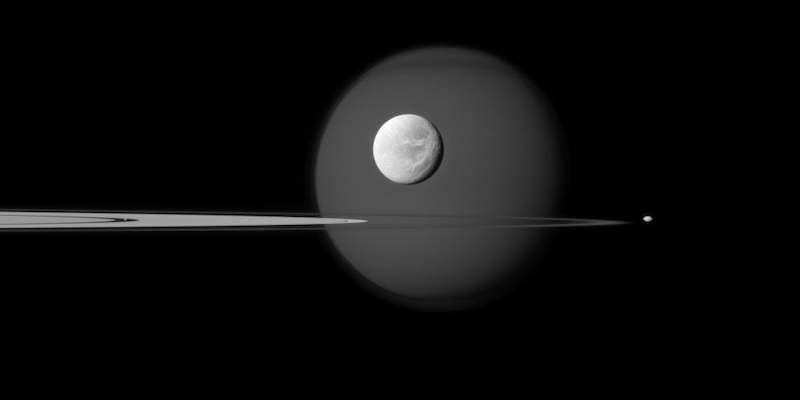
McAuley also drew inspiration from the low efficiency of natural photosynthesis. Even the plants that are best at converting sunlight into chemical energy—maize, sugarcane, and other so-called C4 plants—do so with an efficiency of barely a few percent. Given how much feebler sunlight is on Saturn’s moon Titan than on Earth, Hong Owen and other geneticists in The Quiet War sought to create more efficient photosynthesizers.
The same pursuit of greater efficiency motivates current research on artificial photosynthesis. Natural photosynthesis can already provide chemical fuel: In the US, for example, maize is grown and converted to ethanol. But it takes a plot of 9.6 hectares, or 24 acres, to produce enough ethanol to fill one gasoline truck. Maize must also be ground up and fermented to produce the ethanol. Artificial photosynthesis aims to bypass such efficiency-sapping steps by converting sunlight more directly into fuels and other useful chemicals.
Photosynthesis requires splitting water molecules into hydrogen and oxygen. However, the oxygen generated during this process is highly corrosive, attacking—or “rusting”—the catalysts responsible for lowering the reaction’s energy barrier. Natural photosynthesis mitigates this damage by continually resynthesizing the core protein complex of photosystem II whenever it degrades. Although finding a cheap, robust catalyst for artificial photosynthesis remains elusive, researchers are making steady progress. In fact, artificial systems have already surpassed natural plants in solar-to-fuel efficiency by a factor of 5. To close the remaining gaps, scientists are actively developing innovative hybrid nanomaterials to serve as next-generation catalysts.
Since artificial photosynthesis remains far from established more than a century after Ciamician offered his vision, one might have grounds for despondency. But I’m optimistic, in part because the path from basic research to practical technology can be long. Engineer and inventor George Cayley expounded the physics of flying machines in his treatise “On Aerial Navigation” (1809–1810). The Wright brothers acknowledged their debt to Cayley, but nearly a century passed before they demonstrated a motorized aircraft capable of sustained flight in 1903.
So let’s not lose hope in artificial photosynthesis—or in other transformative technologies, such as nuclear fusion. Addressing the British Association for the Advancement of Science in 1920, astrophysicist Arthur Eddington suggested that stars derive their energy from the fusion of hydrogen into helium and that harnessing such latent energy could one day be used “for the well-being of the human race.”
Thought Experiment is a column in which our editors reflect on the connections between physics, culture, history, and everyday life.
—Charles Day
Charles Day is a Senior Editor for Physics Magazine.