




Why Brittle Solids Crack Under Pressure
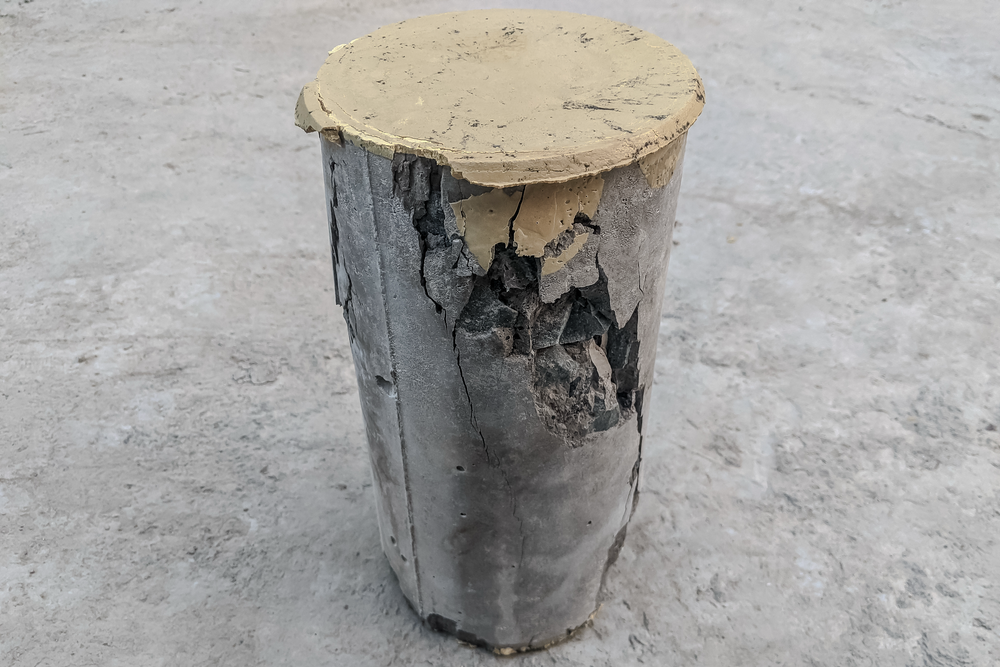

What happens when a rock, ceramic, or other brittle solid is squeezed along one axis? Surprisingly, cracks often form parallel to that axis, as if the material were being pulled apart along the perpendicular direction. Despite decades of study, the origin of this axial splitting has remained unclear. Now researchers have proposed that the effect stems from a concentrated region of tension that develops in the material’s interior [1]. The team’s findings could help scientists predict geological fractures and design damage-tolerant structures.
Before this study, three main explanations for compressive splitting had been put forward. One posits that tiny cracks already present in the material grow under pressure, eventually joining up to form larger fractures. Another theory frames the effect as a thermodynamic competition between intact and split configurations. And the third points to internal stresses that cause regions of the material to slip past one another. Each explanation captures part of the picture, but none can fully explain why splitting begins similarly in a wide range of materials.
Kaushik Dayal of Carnegie Mellon University (CMU) in Pennsylvania and his colleagues suggest that the effect instead results from a simple geometric constraint. When a brittle solid is squeezed between two rigid plates in a compression test, it naturally tends to widen sideways. But the two edges of the solid being pressed by the plates are not free to expand. So the middle widens the most, and the edges cannot widen at all. This restriction creates a stretching force (tensile stress) in the solid’s interior, even though the overall load is compressive. Axial splitting starts when this tension exceeds the material’s tensile strength.
The researchers explain that their mechanism can be considered the inverse of another phenomenon: If a thin rubber sheet is clamped at both ends and then stretched, wrinkles will appear aligned along the stretching direction. Such a sheet cannot contract sideways at its ends, which leads to compression perpendicular to the stretching and thus the wrinkling.
Dayal and his colleagues derive a predictive strength law. This law relates the solid’s axial-splitting resistance to its tensile strength and geometry and to the pressure limiting its sideways expansion. To verify this law, the researchers compared its predictions with compression-test data in the literature for six brittle materials, ranging from rocks to ceramics. They found good agreement between the predictions and the data, lending support to their proposed mechanism.
“These results suggest that a brittle material’s compressive strength depends not only on the material itself but also on its shape and on how it is constrained,” says CMU team member Maryam Khodadad. “Recognizing these hidden contributions could change how scientists interpret compression experiments and predict failure in these materials.” Already, the researchers’ findings explain why even modest sideways pressure can greatly reduce splitting. This pressure reduces the internal tension that produces cracks.
Martin Ostoja-Starzewski, a mechanics expert at the University of Illinois Urbana-Champaign, is intrigued that “the compressive splitting arises from a deterministic, geometry-controlled mechanism rather than from stochastic distributions of material flaws.” In addition, the work shows that “the usual assumption of independent tensile and compressive strengths breaks down under constrained compression,” he says.
In the future, Dayal and his colleagues hope to explore how their mechanism extends to more complex materials, particularly porous and heterogeneous solids, in which fluid pressure, internal structure, and confinement can influence fracture formation. Such work, the team suggests, could help scientists understand how bone and other biological materials fracture or address problems related to geothermal energy extraction or to underground CO2 storage.
–Ryan Wilkinson
Ryan Wilkinson is a Corresponding Editor for Physics Magazine based in Durham, UK.
References
- M. Khodadad et al., “Compressive splitting in brittle solids: The inverse of wrinkling in sheets,” Phys. Rev. Lett. 137, 196101 (2026).
- J. Zhang et al., “Study on the corrosion behavior and mechanical response of weakly cemented sandstone in alkaline solutions,” PLoS ONE 19, e0309544 (2024).