




Gallium Anomaly May Finally Be Explained
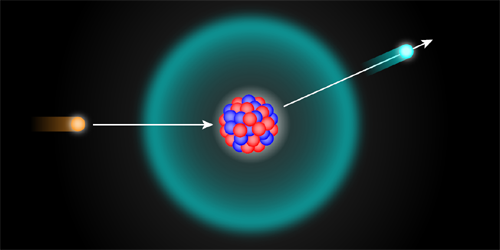

For more than 30 years, scientists have found that roughly 20% fewer electron neutrinos are captured by gallium nuclei than expected. Dubbed the gallium anomaly, this discrepancy has raised the possibility that something fundamental might be missing from our understanding of neutrinos or atomic nuclei. Now Matteo Cadeddu at the National Institute for Nuclear Physics (INFN) and the University of Cagliari, both in Italy, and his colleagues have shown that this mismatch may instead originate from the way the electron-neutrino capture rate is calculated [1]. If confirmed, the team’s results could have implications for other neutrino experiments and could reshape searches for new physics.
When an electron neutrino is captured by a gallium nucleus, an electron is created and a neutron turns into a proton, transforming gallium into germanium. In the standard capture-rate calculation, the behavior of the nucleus is treated separately from that of the neutrino and electron. This approximation simplifies the calculation but may overlook key aspects of the capture process. Cadeddu and his colleagues instead developed a more rigorous approach that fully accounts for the interplay between the nucleus, neutrino, and electron.
Using this technique, the researchers predicted a capture rate about 20% lower than previous estimates, closely matching the experimental results. This finding offers a solution to the gallium anomaly without requiring new physics. It disfavors one of the previously leading explanations: the existence of so-called sterile neutrinos. Scientists had proposed sterile neutrinos to account for several puzzling observations, but increasingly stringent experiments have made it more difficult to develop consistent models for these particles (see Synopsis: Sterile Neutrinos Remain Elusive).
–Ryan Wilkinson
Ryan Wilkinson is a Corresponding Editor for Physics Magazine based in Durham, UK.
References
- M. Cadeddu et al., “Possible solution to the gallium anomaly moving beyond the leptonic wave-function factorization,” Phys. Rev. Lett. 137, 131805 (2026).