




First Nuclear Clocks Kick Off a Precision Race
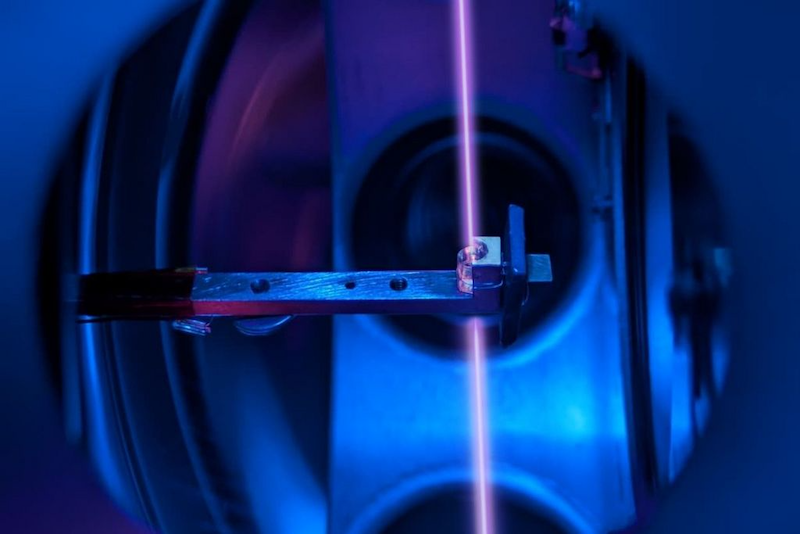

Clocks have always been about more than keeping time. In the 18th century, marine chronometers helped solve the “longitude problem,” enabling sailors to determine their ships’ east–west position at sea [1]. A new generation of ultraprecise clocks may now help researchers navigate uncharted territory beyond the standard model of particle physics. Building on decades of development, two independent teams—one led by Thorsten Schumm of the Vienna University of Technology and Ekkehard Peik of PTB, the German National Metrology Institute [2] and the other by Shiqian Ding of Tsinghua University in China [3]—have reported in Nature the first operating nuclear clocks. Their ticks are set by a transition in the atomic nucleus rather than by transitions of the electrons surrounding it.
Peik says he was “absolutely delighted” by the rapid progress and surprised by the clock’s robustness. Ding says he felt humbled to see decades of work come together in an operating clock. “Two years earlier, that still felt almost too ambitious to imagine,” he says.
These clocks don’t yet match the stability of today’s best atomic clocks, but they hold promise for both practical applications and tests of fundamental physics. Nuclear clocks could eventually become compact and robust, doing away with the ultrahigh-vacuum chambers and elaborate laser-cooling and trapping systems required by today’s most precise atomic clocks.
In optical atomic clocks, the ticking frequency is set by a transition between an atom’s electronic energy levels. A nuclear clock instead uses a transition between quantum states of the nucleus—different configurations of its protons and neutrons. The nucleus’s small size and partial shielding by the surrounding electrons can make these transitions less susceptible to external disturbances. What’s more, the long lifetimes of some excited nuclear states produce narrow natural linewidths—and hence sharp transition frequencies. Together, these features can make a nuclear transition an exceptional frequency reference.
The ticks of an optical clock correspond to the frequency of a tunable laser. Left on its own, the frequency would drift, so it must be stabilized to a reference transition—whether electronic or nuclear. Finding a suitable nuclear transition, however, has been challenging. Most require x-ray or gamma-ray photons, for which tunable, narrow-linewidth lasers are unavailable.
Thorium-229 presents a uniquely practical exception: Its first excited nuclear state lies just 8.4 electron volts above the ground state, corresponding to vacuum-ultraviolet light with a wavelength near 148 nm—within the reach of purpose-built laser sources. The low estimated energy of this transition led Peik and Christian Tamm to propose a thorium-based nuclear clock in 2003 [4].
Over the following two decades, researchers gathered evidence for the excited nuclear state while refining estimates of its energy. A major challenge was simply pinpointing the resonance precisely enough to address it with a narrowband laser. The breakthroughs came in 2024, when researchers first drove the transition directly with laser light (see Viewpoint: Shedding Light on the Thorium-229 Nuclear Clock Isomer) [5] and then measured its frequency with high precision [6].
Those achievements established thorium-229 as a viable frequency reference. Turning that reference into a working clock required one last element: using the nuclei to control the laser in real time. Both teams achieved this control with narrow-linewidth continuous-wave lasers at 148 nm and with absorption measurements that revealed laser drift within seconds. By feeding the absorption signal back to the laser, the researchers anchored the laser’s oscillations to the nuclear transition.
The two experiments reflected a trade-off between laser power and thorium concentration—a consequence of each lab’s history, Schumm says. The European group used a crystal with a relatively high concentration of thorium-229 but a low-power laser (Fig. 1). Faced with limited access to thorium-229, the Chinese group used a lower thorium concentration but compensated by developing a much more powerful laser source. “Ideally, we would like to combine the advantages of both approaches: high VUV [vacuum-ultraviolet] power and more thorium nuclei,” Ding says. “If we can achieve both, the clock stability can improve substantially.”
The clocks reached broadly similar levels of performance. Loosely translated into accumulated errors, their measured instabilities would correspond to gaining or losing one second over 3 million years for the European clock and 19 million years for the Chinese clock. The best optical atomic clocks, by comparison, would gain or lose only one second over tens of billions of years. Davide Calonico, scientific director of Italy’s National Institute of Metrological Research, who wasn’t involved in the work, calls the results a major metrological milestone, noting that the clocks already offer greater frequency stability than “many clocks of comparable complexity.”
The European team has already put its clock to use in a search for ultralight dark matter. Using a stabilized optical-fiber link to transfer the signal from a remote ytterbium-ion clock, the researchers compared the two clocks’ frequencies. Some dark matter models predict variations in fundamental constants that would affect nuclear and electronic transitions—and thus the two clocks’ ticking rates—differently. The team found no variation on timescales up to one day. Despite the clock’s early stage of development, the resulting limits were competitive with leading atomic-clock constraints on dark matter’s coupling to photons and surpassed previous clock limits on certain couplings involving the strong force.
“The nuclear clock opens a genuinely novel window to physics beyond the standard model,” says Elina Fuchs of DESY and Leibniz University Hannover in Germany. Nuclear clocks probe effects on the nucleus and the strong interaction directly, whereas atomic clocks sense nuclear effects only indirectly through their influence on electronic energy levels, she says. Thorium-229 may be especially sensitive, adds Fiona Kirk of the Weizmann Institute of Science in Israel, because its unusually low transition energy may result from an accidental cancellation between much larger contributions. “This cancellation could effectively act as an amplifier for new physics,” Kirk says.
–Matteo Rini
Matteo Rini is the Editor of Physics Magazine.
References
- D. Sobel, Longitude: The True Story of a Lone Genius Who Solved the Greatest Scientific Problem of His Time (Walker and Company, New York, 1995)[Amazon][WorldCat].
- L. Toscani De Col et al., “A thorium-229 optical nuclear clock with feedback loop,” Nature (2026).
- B. Huang et al., “A nuclear clock synchronized to 229Th,” Nature (2026).
- E. Peik and Chr. Tamm, “Nuclear laser spectroscopy of the 3.5 eV transition in Th-229,” Europhys. Lett. 61, 181 (2003).
- J. Tiedau et al., “Laser excitation of the Th-229 nucleus,” Phys. Rev. Lett. 132, 182501 (2024).
- C. Zhang et al., “Frequency ratio of the 229mTh nuclear isomeric transition and the 87Sr atomic clock,” Nature 633, 63 (2024).