




Elucidating Superconductivity with Ultrasound
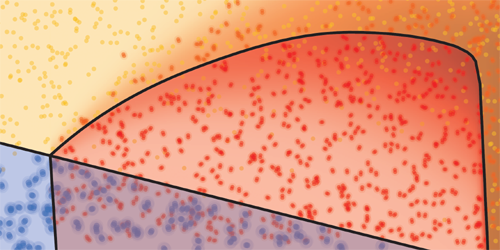

The superconductivity of uranium ditelluride (UTe2) has a low critical temperature typical of superconducting uranium compounds. Yet its response to an applied magnetic field is extraordinary. Not only does the superconductivity survive up to exceptionally strong magnetic fields, a second superconducting phase emerges under the application of even stronger fields, as well as under high pressure. Although that robustness points to an electron-pairing configuration known as spin-triplet pairing—a rarity among superconductors—both phases remain poorly understood. Now Brad Ramshaw of Cornell University and his colleagues have used ultrasound to clarify aspects of both phases [1].
The electrons that pair up in the two superconducting states come from uranium and tellurium atoms, and the precise positions of these atoms within the crystal structure control the superconductivity. Subjecting UTe2 crystals to pulses of ultrasound shifts the uranium and tellurium atoms, perturbing the superconductivity. The perturbed electrons, in turn, influence the crystal’s elastic modulus and sound attenuation. By precisely measuring how those two mechanical properties vary with pressure and temperature, Ramshaw and his colleagues could infer key properties of the superconducting phases.
Although the conventional, so-called Bardeen-Cooper-Schrieffer (BCS) theory was devised for singlet pairing, its mathematical framework can accommodate triplet pairing. Ramshaw and his colleagues’ measurements were consistent with the first phase being BCS-like with triplet pairing. By contrast, the second phase evinced vigorous fluctuations in the supercurrent, a hallmark of unconventional superconductivity. The researchers propose that the pairing glue is ferromagnetic in nature and that the pairing occurs across different electronic bands brought closer by high pressure.
–Charles Day
Charles Day is a Senior Editor for Physics Magazine.
References
- S. Kamat et al., “Vanishing phase stiffness and fluctuation-dominated superconductivity in UTe2,” Phys. Rev. X 16, 041006 (2026).