




How To Arrange Hundreds of Atoms Between Two Mirrors
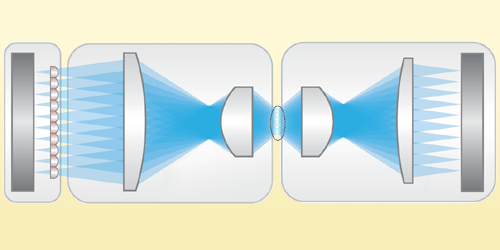

Neutral-atom arrays are a leading platform for quantum computing. Previously, researchers developing such arrays had to choose between scalability and efficiency. Now Anna Soper of Stanford University and colleagues have demonstrated a way to combine both attributes in the same setup [1].
In a conventional neutral-atom quantum computer, each atom is manipulated and read using lasers in free space. This approach is inherently scalable: Since the laser optics are spatially separate from the atom array, the array can be extended without the additional hardware getting in the way. However, each atom emits unreliably and in all directions, making readout inefficient. Researchers can orchestrate stronger, more reliable light–atom interactions by placing the atoms in optical cavities. But having to add a new cavity for each additional atom makes such setups difficult to scale up.
Recently, Soper and colleagues demonstrated a possible resolution to this dichotomy with their “cavity-array microscope.” In that device, a single large optical cavity hosted multiple optical modes, allowing 40 atoms to be addressed simultaneously [2].
Now the researchers have improved on this technique. Their enhanced device consists of an optical cavity defined by a pair of mirrors about a meter apart. The atoms occupy a 2D array at the midpoint, perpendicular to the cavity’s axis. Whereas such a cavity would usually host a single optical mode with one focal point, Soper and colleagues use a series of lenses within the cavity to form the light into multiple independent transverse modes. By improving the quality of the optics compared to their earlier demonstration, the researchers generated 603 discrete optical modes capable of addressing a corresponding number of atoms. In future work, they aim to connect multiple cavity arrays, whose high efficiency could enable large-scale quantum networks.
–Sophia Chen
Sophia Chen is a freelance science writer based in Columbus, Ohio.
References
- A. Soper et al., “Stability, degeneracy, and scalability of a 600-site cavity array microscope,” Phys. Rev. X 16, 041009 (2026).
- A. L. Shaw et al., “A cavity-array microscope for parallel single-atom interfacing,” Nature 650 (2026).