




The Giant Permittivity of Nanoconfined Water
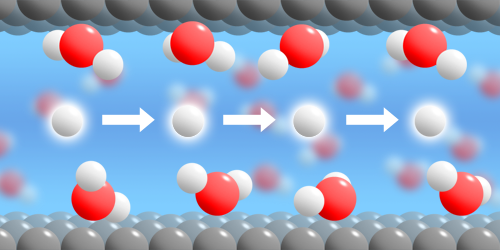

In 2018, researchers confined a film of water between plates a few nanometers apart and found that its dielectric constant perpendicular to the plates was modestly suppressed, while its in-plane value was massively enhanced. Later experiments showed an enormous increase in the film’s in-plane proton conductivity. Now Mehdi Neek-Amal and François Peeters at the University of Antwerp in Belgium have proposed a microscopic mechanism for these effects [1].
Previously, Neek-Amal and Peters, along with colleagues, developed a model that explained the dielectric properties of a water film by treating it as three distinct capacitors: one each for the top and bottom interfaces and one for the water’s bulk. But water confined to a gap narrower than about 5 nm is pretty much all interface and no bulk. Such “nanoconfinement” cases demand a new theory—one that considers correlations among water molecules’ electric dipoles.
In bulk water, fluctuations in the orientation of a given molecule’s dipole are correlated with those in a 3D shell of near neighbors. But when water is confined within a gap a few nanometers thick, the molecular dipoles are forced to lie within a single plane. This constraint extends the in-plane correlation distance, meaning domains of hundreds of similarly aligned, hydrogen-bonded molecules fluctuate together. Accounting for this effect, the researchers derived a scaling law for water’s dielectric response that applies to films approximately 1–5 nm thick—the regime in which water crosses over from bulk-like behavior to a strongly confined, quasi-2D state. The same correlated 2D network of hydrogen bonds also provides an efficient route for charge transport, explaining the high in-plane proton conductivity of nanoconfined water.
–Marric Stephens
Marric Stephens is a Corresponding Editor for Physics Magazine based in Bristol, UK
References
- M. Neek-Amal and F. M. Peeters, “Giant dielectric anisotropy and enhanced in-plane conductivity in nanoconfined water,” Phys. Rev. Lett. 137, 146201 (2026).