




Killer Cells Coordinate to Target Cancer
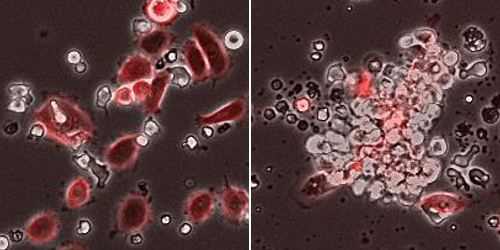

Biological cells affected by certain cancers can be both identified and destroyed by so-called natural killer cells (NKCs). Yet despite decades of study, the collective dynamics of NKCs when interacting with cancerous or healthy cells remain unclear. Now Yun-Xuan Zhang and her colleagues at the National Central University in Taiwan have tracked these dynamics using high-resolution microscopy [1]. The team’s straightforward way of distinguishing the behavior of cancerous cells from that of healthy ones might help scientists develop more effective cancer immunotherapies.
The researchers investigated how NKCs behaved when mixed with either oral cancer cells or healthy fibroblasts—common cells found in connective tissue. Using fluorescent and phase-contrast microscopy, they recorded the positions and movements of the NKCs, cancer cells, and fibroblasts every few minutes, across tens of hours.
When interacting with fibroblasts, the NKCs continuously scouted around the healthy cells without forming large clusters and without affecting the motion of the fibroblasts. By contrast, when facing cancer cells, the NKCs attached themselves to those cells, recruited nearby NKCs to form large clusters, and repeatedly approached the cancer cells. While this harrying motion proceeded, the NKCs attacked the cancer cells, as expected, by emitting toxic substances, which were not directly observed in the current study. In response, the cancer cells also aggregated into large clusters to lessen the impact of the attack before they eventually died.
In future work, the researchers hope to explore the microscopic interactions responsible for these different dynamics and to establish whether the behaviors are general for all types of cancerous and healthy cells.
–Ryan Wilkinson
Ryan Wilkinson is a Corresponding Editor for Physics Magazine based in Durham, UK.
References
- Y.-X. Zhang et al., “Collective dynamics of natural killer cells interacting with cancer and fibroblast cells,” Phys. Rev. E 113, L062401 (2026).