




Finding a “Curveball” Equivalent for Microscopic Particles
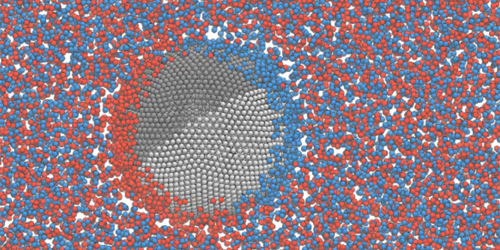

When a pitcher throws a curveball, the spinning baseball swerves in a direction perpendicular to both its initial motion and its rotation axis. This phenomenon, well understood on macroscopic scales, is called the Magnus effect. Now, Zachary Sherman and James Swan of the Massachusetts Institute of Technology describe an analogous effect that occurs on microscopic scales when a small charged particle suspended in an electrolyte is exposed to a strong electric field. The effect could be useful in the study of self-propelling active matter as a new technique for moving particles in a prescribed way.
Sherman and Swan ran numerical simulations that showed how particles could exhibit what they call the spontaneous electrokinetic Magnus effect. When a strong electric field is applied to a particle suspended in an electrolyte, the particle starts spinning because of a phenomenon called Quincke rotation. If the suspended particle has a net charge, it also moves along in the direction of the electric field through electrophoresis. This combination, the researchers found, triggers a Magnus-effect-like motion in a direction orthogonal to the field and the rotation axis. Using their simulations, the researchers developed an analytical theory that explains the effect and its dependence on various parameters, such as the particle’s size and the strength of the electric field.
The researchers say that this effect may be useful in situations where different kinds of particles need to be separated. For example, reactions to make certain chemicals often produce a slew of unwanted by-products; it may be possible to design particles that preferentially bind to the desired chemicals and then extract them when an electric field is applied.
This research is published in Physical Review Letters.
–Erika K. Carlson
Erika K. Carlson is a Corresponding Editor for Physics based in Brooklyn, New York.