




Reducing the Dark Current
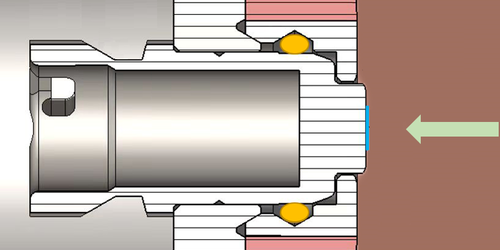

Free-electron lasers (FELs) have an electron problem: a “dark” current that can propagate with the electron beam, limiting the performance of the system. Now Guan Shu of Zhangjiang Laboratory in China and colleagues have developed a method that can reduce the strength of this unwanted dark current by 3 orders of magnitude [1]. Because their method requires no structural changes to existing equipment, Shu says it could be easily implemented in existing FELs. Their bright beams of x rays—generated by electrons—are increasingly popular for structural studies.
Most high-repetition-rate free-electron lasers are fed by very-high-frequency (VHF) electron guns. A VHF electron gun contains a photocathode that releases electrons when hit with a laser. These electrons are accelerated by a strong electric field and exit the photocathode as a beam through a port at the front. But the same field generates other electrons by pulling them off the photocathode’s surface and from nearby copper surfaces via the field effect. These so-called dark electrons—they don’t need light to free them—can cause unwanted heating that degrades the main electron beam and damages the beam line.
To weaken the dark current, researchers have typically lowered the gun voltage. But that route reduces the brightness of the main electron beam. Shu and colleagues found an alternative solution: modifying the plug upon which the photocathode material is deposited and grown. The team showed that by pushing the plug around 0.5–1 mm deeper than a standard plug, they were able to reduce the intensity of the dark current by nearly 2 orders of magnitude. The over-inserted plug also had another benefit—it defocused the dark current. Rather than propagating downstream to join the main beam, the dark current struck the VHF gun cavity walls before it could leave the photocathode.
–Katherine Wright
Katherine Wright is the Deputy Editor of Physics Magazine.
References
- X.-H. Wang, “Experimental demonstration of dark current mitigation by an over-inserted plug in a normal conducting very-high-frequency gun,” Phys. Rev. Accel. Beams 28, 043401 (2025).