




The Unexpected Ubiquity of the Phonon Thermal Hall Effect

In the late 19th century, two physicists independently discovered the Righi-Leduc, or thermal Hall, effect: In the presence of a perpendicular magnetic field, a longitudinal heat flux generates a transverse temperature gradient. In metals, the thermal Hall effect is tied to the more familiar electric Hall effect through the Wiedemann-Franz law, which states that electronic thermal conductivity divided by electrical conductivity is directly proportional to temperature.
In electrical insulators, lattice vibrations called phonons carry heat. Until the early 21st century, it was thought that phonons, despite being neutral, could still generate a nonzero thermal Hall signal, provided they are scattered by electron spins. However, since then many experiments worldwide have found that such a signal can be detected even in crystalline insulators with no unpaired electron spins. The decisive discovery was made last year by Xiaobo Jin of Fudan University in China and his colleagues, who found a phonon thermal Hall effect in two simple semiconducting materials: silicon and germanium [1]. Whereas the origin of the effect is hotly debated, its importance in challenging views of how magnetic fields and heat fluxes interact is undisputed.
The phonon thermal Hall effect was first observed in 2005 in a paramagnetic insulator, terbium gallium garnet [2]. Absent a magnetic field, the crystal’s phonon thermal conductivity is a scalar. When the researchers applied a magnetic field, it became a tensor, whose off-diagonal terms correspond to transverse thermal conductivity. In 2020, a thermal Hall signal was observed in strontium titanate [3]. The material is a nonmagnetic insulator, but it also hosts exotic phonons and would be ferroelectric save for quantum fluctuations. In 2023, a thermal Hall signal was detected in black phosphorus [4]. This material is an elemental insulator but not a trivial one. By then, the phonon thermal Hall effect could reasonably be attributed to the complexity of its crystalline hosts. But that view became untenable when Jin and his colleagues observed, surprisingly, the effect in silicon, followed recently by its reported observation in diamond [5].
Silicon is arguably the most important element for contemporary civilization, and its transport properties have been thoroughly explored for almost a century. An accurate description of thermal conductivity in semiconductors, starting from first principles [6], has been one of the most remarkable accomplishments of computational condensed-matter physics in the 21st century. Furthermore, detecting the phonon thermal Hall effect in silicon required a modest setup based on decades-old technology. Why had it not been observed before?
No experimentalist was looking for it. Previous theories of the phonon thermal Hall effect focused on either phonon scattering by impurities or phonon chirality acquired by nontrivial topology. Nobody foresaw its occurrence in garden-variety semiconductors. Disorder, which was suspected by several theories to be the driver of the effect, turns out to destroy it [7].
Strikingly, experiments on a variety of compounds have revealed universal features of the effect [4]. In every insulator studied so far, the transverse and the longitudinal thermal conductivities peak at roughly the same temperature: approximately one tenth of the Debye temperature, the value at which heat alone can excite a crystal’s highest-energy phonons. Moreover, at this peak temperature, the ratio of transverse to longitudinal conductivities remains roughly the same across different insulators, even though the amplitudes of the two types of conductivity vary across materials by many orders of magnitude.
This link between transverse and longitudinal thermal conductivity indicates that the impact of a magnetic field on phonon–phonon scattering plays a crucial role in the phonon thermal Hall effect. To see why, consider the general case of two phonons colliding to form a new, more energetic phonon or the case of one phonon disintegrating into two new phonons. These events happen because the phonon number is not conserved. But at a certain temperature, the conductivity reaches its maximum because the increase in phonon population by warming compensates for the increase in phonon–phonon scattering. In the phonon thermal Hall effect, this happens for the transverse and longitudinal conductivities simultaneously.
Phonon–phonon scattering arises because real crystals have anharmonic (asymmetric) potentials rather than harmonic (symmetric) ones. Most theories of the phonon thermal Hall effect have focused on how a magnetic field alters individual phonon trajectories rather than interactions among phonons. In the harmonic approximation, phonon–phonon scattering doesn’t exist, and longitudinal thermal conductivity is infinite. Ignoring anharmonicity is a nonstarter [8].
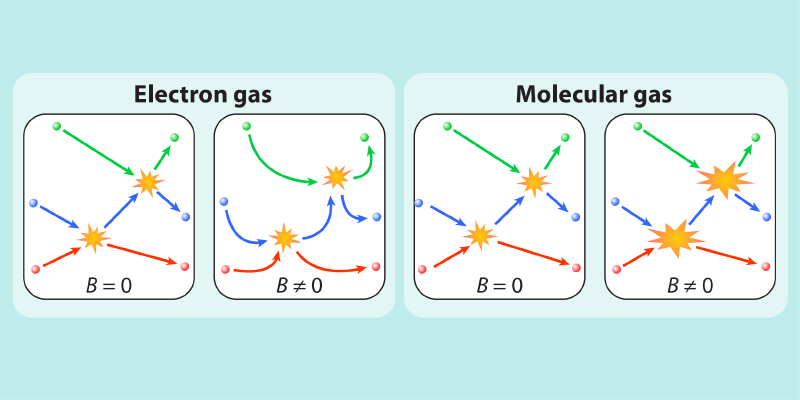
A revealing comparison can be made to the half-forgotten Senftleben-Beenakker effect, by which an applied magnetic field changes the thermal conductivity, viscosity, and other transport properties of dilute polyatomic gases [9]. The effect has a thermal Hall component. Yet despite the textbook analogy between a molecular gas and a phonon gas, the Senftleben-Beenakker effect has been strangely absent in the quest to explain the phonon thermal Hall effect. The driver of the response in a molecular gas is the influence of the magnetic field on the molecular collision probability rather than on the trajectory of neutral molecules (Fig. 1).
It remains unclear if the phonon thermal Hall effect can be described in a semiclassical picture, or if the magnetic-field-induced geometric phase of phonons [8, 10] makes a purely quantum treatment indispensable. The ultimate solution to this hot topic may revive other cold cases besides the Senftleben-Beenakker effect. The list includes the Lagrangian and Eulerian descriptions of a phonon fluid [11], the electromagnetic pseudomomentum in crystals [12], the insufficiency of anharmonicity for ergodicity [13], and the breakdown of the Born-Oppenheimer approximation in a magnetic field [14].
But even before the problem is solved, there is little doubt that our conventional view of the interplay between a magnetic field and heat flux in a solid will never be the same. Beyond its fundamental interest, the influence of an external field on the flow of heat may eventually be useful in the quest to manage thermal transport at small scales.
References
- X. B. Jin et al., “Discovery of universal phonon thermal Hall effect in crystals,” Phys. Rev. Lett. 135, 196302 (2025).
- C. Strohm et al., “Phenomenological evidence for the phonon Hall effect,” Phys. Rev. Lett. 95, 155901 (2005).
- X. Li et al., “Phonon thermal Hall effect in strontium titanate,” Phys. Rev. Lett. 124, 105901 (2020).
- X. Li et al., “Phonon thermal Hall angle in black phosphorus,” Nat. Commun. 14, 1027 (2023).
- M. Matusiak et al., “Observation of thermal Hall effect in diamond,” arXiv:2608.25726.
- L. Lindsay et al., “Ab initio thermal transport in compound semiconductors,” Phys. Rev. B 87, 165201 (2013).
- Y. Ling et al., “Phonon thermal Hall effect in quartz and its absence in silica,” SciPost Phys. 21, 036 (2026).
- K. Behnia, “Phonon thermal Hall as a lattice Aharonov-Bohm effect,” SciPost Phys. Core 8, 061 (2025).
- J. J. M. Beenakker and F. R. McCourt, “Magnetic and electric effects on transport properties,” Annu. Rev. Phys. Chem. 21, 47 (1970).
- T. Saito et al., “Berry phase of phonons and thermal Hall effect in nonmagnetic insulators,” Phys. Rev. Lett. 123, 255901 (2019).
- R. Peierls, Surprises in Theoretical Physics, Princeton Series in Physics (Princeton University Press, 1979)[Amazon][WorldCat].
- D. F. Nelson, “Momentum, pseudomomentum, and wave momentum: Toward resolving the Minkowski-Abraham controversy,” Phys. Rev. A 44, 3985 (1991).
- S. Lepri et al., “1953: Fermi’s ‘little discovery’ and the birth of the numerical experiment,” arXiv:2311.09769.
- L. Yin and C. Alden Mead, “Magnetic screening of nuclei by electrons as an effect of geometric vector potential,” J. Chem. Phys. 100, 8125 (1994).