




Airy insight into the physics of Anderson localization
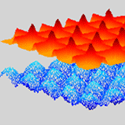

The Anderson localization phenomenon is notoriously difficult to access experimentally. Substantial progress has been made recently in cold atomic systems, where it is possible to prepare a system in a localized state and directly monitor the transport and localization properties of the atomic matter waves (see, for instance, Ref. [1]).
As described in Physical Review Letters by Gabriel Lemarié from Laboratoire Kastler Brossel and his collaborators from the same laboratory and from the Laboratoire PhLAM of the University of Lille, all in France, they can monitor the time evolution of a perfectly localized wave packet and extract information about the critical state of Anderson’s transition in three dimensions. The scientists also provide an explicit analytical expression for the critical wave function in terms of an Airy function, overarching all three regimes of Anderson insulation, criticality, and diffusive metallicity.
The reported advance is an excellent example of a successful cold-atom simulation of a prohibitively complicated condensed matter phenomenon. – Yonko Millev
[1] M. Sadgrove, Physics 1, 41 (2008).