




Chemistry class
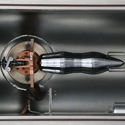

The Avogadro constant—the number of atoms in one mole of an element—provides a link between the atomic and macroscopic properties of matter. One state-of-the-art method for improving the accuracy of this fundamental constant is to use precision x-ray crystallography of highly crystalline silicon spheres: one obtains Avagadro’s number from the ratio of the volume of a mole of silicon (known from its mass) relative to that of a single unit cell in the crystal.
This technique has, however, been plagued by large measurement uncertainties. The main difficulty is accurately determining the isotopic composition of a natural silicon crystal, a key measurement for determining the Avogadro constant. In a paper published in Physical Review Letters, Birk Andreas at Physikalisch-Technische Bundesanstalt in Braunschweig, Germany, with colleagues in Europe and the US report on x-ray studies with a silicon crystal highly enriched with the silicon- isotope. They compare their results with several others and show a significant improvement in the accuracy of the Avogadro constant, which they determine to be with relative uncertainty. Their technique may even allow us to find a replacement for the current platinum-iridium prototype for the value of the kilogram. – Sami Mitra