




How Ice Bridges Form
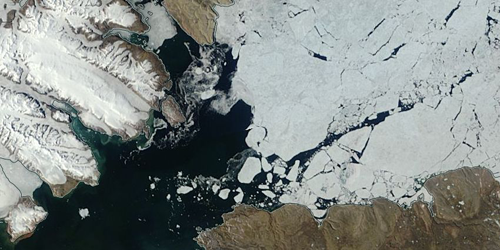

In the straits and channels of the Canadian Arctic Archipelago, chunks of sea ice jam and form frozen bridges nearly every winter. These natural walkways may help polar bears and other animals reach previously inaccessible areas. And they may affect local as well as global climate by preventing ice flow into warmer oceans. Yet there isn’t much knowledge about how ice bridges form. Bhargav Rallabandi and Howard Stone from Princeton University, New Jersey, and colleagues have now developed a theoretical model that details some of the conditions necessary for ice-bridge formation. What’s more, the authors say that the model might also be applicable to the jamming of dense granular flows in confined geometries.
The team modeled the motion of a layer of sea ice along a narrow Arctic-like channel with a length much larger than its width. The flow of the layer is driven by an external wind that acts on its top surface, but it’s also hindered by water drag on the bottom surface and by internal stresses. The researchers assumed that these internal stresses, which depend on the channel width and the thickness and compactness of the ice field, dominate the water drag for jammed ice. Under this assumption, the model predicts that, for a given wind stress and minimum and maximum widths of the channel, an ice bridge will only form beyond some critical thickness and compactness of the layer. These critical thresholds may prove useful in predicting ice-bridge formation and breakup in a warmer world with thinner ice and slower winds.
This research is published in Physical Review Letters.
–Ana Lopes
Ana Lopes is a Senior Editor of Physics.