




Pinpointing Ebbs and Flows of Commuter Traffic
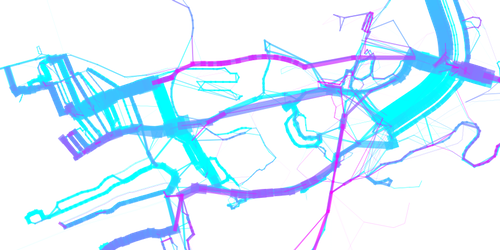

Usage of public transport is not uniform during the day or across a city. Analysis of public transport networks has mostly been limited to the topology of the routes and how different routes connect. Now researchers have developed an analysis method to probe these networks that accounts for flow differences between different branches of the network and between different times of day.
Mirian Izawa from the University of Brasília, Brazil, and colleagues consider vehicles as particles distributed around a circle. The position of a particle indicates the time of day, while its size represents the passenger number. To analyze this system, they calculate its center of mass, a value that expresses the concentration of trips or passengers at any given time. This approach allowed the team to highlight asymmetries in flow of passengers and to pinpoint locations and times of peak flow.
Analyzing bus transport data from Brazil’s capital Brasília, the team identified a pronounced “pendulum flow” of people from residential areas to the business district in the morning and the reverse flow, stretched over a longer time period, in the early evening. They also pinpointed weak points in the system—the most crowded stops and routes and the busiest travel times, information of interest to transport planners and commuters alike. According to the researchers, this methodology could be used to analyze other networks with uneven flows, such as power and financial networks.
This research is published in Physical Review E.
–Katherine Wright
Katherine Wright is a Contributing Editor for Physics.