




Sensing Electric Fields in Ion Sources
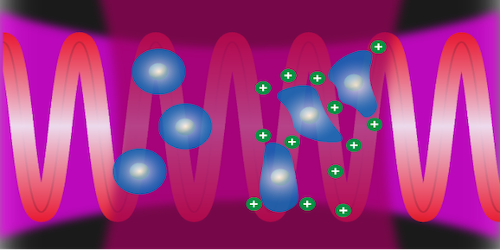

Focused ion beams (FIBs) are powerful tools for imaging and preparing materials, semiconductor circuits, and biological samples. An important class of FIB sources produces the ions from cold, trapped neutral atoms—an approach that offers high brightness and versatility in the delivered ionic species. The electric fields produced by the charged ions can degrade the beam quality and brightness, but characterizing and controlling these fields has proven challenging. A new method demonstrated by Alisher Duspayev and Georg Raithel of the University of Michigan, Ann Arbor, holds promise for overcoming this challenge [1]. The method, based on embedding Rydberg atoms in an ion cloud, offers a noninvasive and versatile way to probe the electric-field distribution in the cloud under a broad range of conditions.
The idea exploits the pronounced electric-field sensitivity of Rydberg atoms, which have their outermost electron excited into a high-lying energy level where it is only weakly bound. These atoms exhibit strong so-called Stark effects, in which an electric field produces large shifts of the atomic spectral lines. Duspayev and Raithel use laser beams to create both ions and Rydberg atoms from rubidium atoms trapped in a cavity. They then characterize the Rydberg spectra with high-precision spectroscopy. Analyzing such spectra, they reconstruct the electric field produced by the ions inside the ion source. Importantly, the duo shows that, by using two sets of rubidium Rydberg states with different electron energies and angular momenta, the scheme can probe a broad range of strengths and distributions of the electric field experienced by the Rydberg atoms.
Next the duo plans to incorporate the scheme into a working FIB source using the derived electric-field information to drive a feedback loop that optimizes the ion-beam quality, says Raithel.
–Matteo Rini
Matteo Rini is the Editor of Physics Magazine.
References
- A. Duspayev and G. Raithel, “Electric field analysis in a cold-ion source using Stark spectroscopy of Rydberg atoms,” Phys. Rev. Appl. 19, 044051 (2023).